Why Your Support Team Is Answering the Same Questions Every Day (And What It's Costing You)
Why Your Support Team Is Answering the Same Questions Every Day (And What It's Costing You)
TL;DR: Most business support teams spend the majority of their day answering the same 20 questions on repeat. That is not a people problem. It is a systems problem. Customer support automation handles the repetitive 55-70% automatically, frees your team for work that actually creates value, and turns your support operation from a cost centre into a revenue driver. This article breaks down the real cost, what smart businesses are doing instead, and the tool I recommend.
I have spoken to hundreds of business owners over the past 30 years. The support conversation comes up almost every time. And it almost always sounds the same: "We are drowning in messages." "My team is exhausted." "We keep hiring but it never feels like enough."
Here is the thing nobody says out loud: most of that workload is not complicated. It is just repetitive. The same questions, from different customers, every single day. What are your hours? Where is my order? What is your return policy? How do I reset my password?
Your team is not struggling because the work is hard. They are struggling because the volume of easy work is burying them. And while they are stuck answering question 847 about your shipping timeline, the customer who actually needed real help just waited 40 minutes and gave up.
That is the real cost of not having customer support automation in place. And in this article I am going to show you exactly what that looks like in numbers, what the best businesses are doing about it, and what tool I use and recommend to fix it.
What Is the Real Cost of Repetitive Customer Support?
Repetitive customer support is one of the most expensive hidden costs in a growing business. A 2025 survey by Tidio found that small business owners and their teams spend an average of 10 to 15 hours per week answering customer queries, and the majority of those queries are repetitive. That is nearly two full working days every week, gone. Not on strategy. Not on sales. On copy-pasting the same answer you gave yesterday.
Now do the maths on your own business. If you have two support agents at a modest salary, and they are spending 60% of their time on FAQ-level questions that could be automated, you are paying for that waste every single month. Not because your team is inefficient. Because your system is not built for volume.
The costs go deeper than salary. Every time a customer asks a question and has to wait for a human to reply, there is a chance they leave. Research from Text.com's own customer base shows that businesses using AI-assisted support see average order values increase by 25% because customers who get fast answers buy more. Customers who wait, often do not buy at all.
And then there is the overnight problem. A customer browsing your Shopify store at 11pm wants to know if you ship internationally. There is no one there to answer. So they close the tab. That sale is gone. An always-on AI customer service system answers that question instantly, at 11pm, on a Sunday, without you paying a single cent in overtime.
How Much of Your Support Volume Can Actually Be Automated?
AI customer support automation reliably handles 55 to 70% of incoming support volume without any human involvement for most small and medium-sized businesses. This covers order status checks, business hours, return policies, product availability questions, and FAQ-type queries. The remaining 30 to 45% that needs human judgment, such as complaints, policy exceptions, and emotionally complex situations, gets escalated with full context already attached so your agent does not have to start the conversation from scratch.
That figure is important to understand properly. Some vendors will tell you AI can automate 89% or even 90% of queries. The honest number for most businesses in production is 55 to 70%. According to a detailed breakdown by Builts AI, vendors measuring "automation rate" in demos are counting acknowledgment messages and information gathering steps. Businesses measuring actual resolution rate in production, meaning tickets fully closed without human touch, see results in the 55 to 70% range. That is still a transformative number. More than half your current support volume, handled automatically.
What makes the biggest difference is not the AI tool you pick. According to Gartner's 2025 AI Implementation Survey, 62% of underperforming AI customer service projects fail because of insufficient data preparation, not because the technology does not work. An AI support system is only as good as the knowledge base you give it. That means documenting your most common questions and answers before you deploy anything.
Why This Is a Systems Problem, Not a Staffing Problem
The instinct when support volume grows is to hire. Another agent. Then another. Each hire costs you $35,000 to $55,000 per year when you factor in salary, onboarding, and the three months it takes before they are genuinely productive. And in year one, what are they spending most of their time doing? Learning your product, making mistakes, and answering the same 20 questions your previous hires were answering.
The smarter businesses have figured out that this is not a headcount problem. It is a systems problem. And the solution is not replacing people. It is building a system that absorbs the repetitive volume so your people can do the work that actually requires a human.
Gartner reported in late 2025 that only 20% of customer service leaders had actually reduced agent staffing after deploying AI. The other 80% kept the same team size and simply handled significantly higher volumes. Your team does not disappear. They get better at their jobs because they stop spending their days on things a system could handle.
Think about what a new support hire's first six months normally looks like. They spend weeks learning your product. They make errors because they do not know every policy yet. They are slow because they have to look everything up. Now imagine that same hire on day one with an AI copilot that suggests accurate, on-brand responses in real time. That new hire performs like a six-month veteran from the first conversation. That is not a nice-to-have feature. That is a serious competitive advantage in a market where customer experience drives retention.
What Does Good Customer Support Automation Actually Look Like?
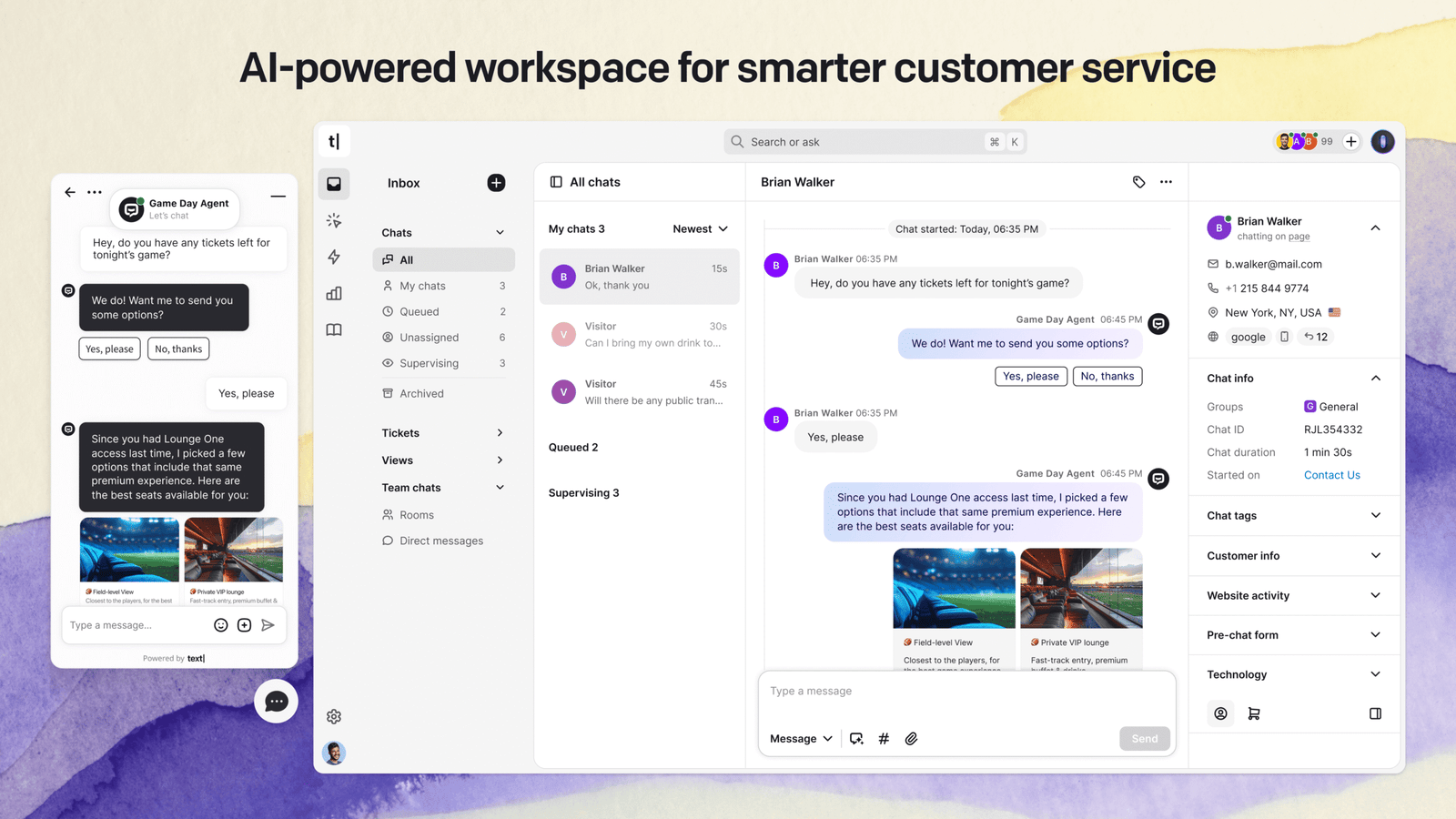
Good customer support automation is not the clunky decision-tree chatbot that frustrates everyone and has no escape route. That version earned a bad reputation for a reason. What is available now is fundamentally different. Modern AI support agents understand natural language, maintain context across a full conversation, pull answers from your actual business knowledge base, and hand off to a human with every detail already captured when the situation needs it.
The case study that always gets my attention is Wembley Stadium. They deployed AI-assisted support and added $1.5 million in revenue in six months. Not by cutting headcount. By turning their support function into a sales channel. Every conversation became an opportunity to generate a lead, upsell a hospitality package, or convert a hesitant buyer. Their agents stopped answering parking directions and started closing deals.
Sephora automated 125,000 support cases per year using the same approach. That is not 125 cases. That is 125,000 cases per year handled without a human typing a single reply. Their team moved to the interactions that required real judgment, empathy, and product expertise. The operational cost of those routine 125,000 cases effectively went to near zero.
These are not outliers. Businesses across ecommerce, SaaS, and professional services are running this model right now. The businesses that are not are still paying humans to answer the same 20 questions on repeat.
What Should You Look for in an AI Customer Service Platform?
Not all AI customer service platforms are built the same, and picking the wrong one is an expensive mistake. Here are the things that actually matter when you are evaluating options for a small or growing business.
The first thing to look for is multi-channel inbox management. Your customers are not messaging you on one channel. They are on your website chat, email, WhatsApp, Facebook Messenger, and Instagram. If your team is switching between five different tools to manage those conversations, they are losing context, missing messages, and delivering inconsistent answers. One unified inbox where every channel feeds into the same place is not a luxury. It is the baseline requirement.
The second thing is AI that suggests replies rather than only replacing agents entirely. The hybrid model, where AI handles the routine cases automatically and assists human agents on the complex ones, outperforms both full automation and full manual handling. A system with an AI copilot that recommends accurate responses in real time means your agents work faster and make fewer mistakes, especially the new ones.
Third, look for Shopify integration if you run an ecommerce store. Abandoned cart recovery, order status automation, and post-purchase follow-up handled through chat is a direct revenue driver. Customers who get proactive messages after browsing or abandoning a cart convert at significantly higher rates than those who do not hear from you until they email in with a complaint.
Fourth, look at the compliance credentials. Any platform handling customer data needs to be GDPR compliant, and ideally PCI DSS certified if you are dealing with payment-adjacent conversations. This is not a checkbox exercise. It is basic operational protection.
The Tool I Recommend: Text.com
After testing a range of options, the platform I use and recommend is Text.com. It brings together live chat, AI helpdesk, chatbot automation, and multi-channel inbox management in a single platform. More than 35,000 businesses are running on it right now, including PayPal, IKEA, Sephora, and Ryanair.
What I like about it specifically for small and growing businesses is that it does not require an enterprise IT team to implement. You point it at your website URL, it builds a knowledge base within minutes, and you can have your first AI agent handling conversations the same day. Most teams start by letting the AI handle the most repetitive questions to clear the backlog, then expand from there as they see what it can do.
The AI copilot feature is worth highlighting separately. Every agent, whether they have been on your team for three years or three days, gets real-time response suggestions drawn from your knowledge base. That levels up your entire support operation without a single training session. New hires become productive immediately instead of after three months.
Text.com also handles the Shopify angle properly. The integration lets you automate order status queries, recover abandoned carts through chat, and send post-purchase follow-ups that increase repeat purchase rates. For ecommerce businesses, support is not just a cost to manage. It is a direct sales channel when it is set up correctly.
They offer a 14-day free trial with no credit card required. I recommend reading through my full breakdown of Text.com before you sign up so you understand which plan and setup makes sense for your business size and support volume.
The Bottom Line
Your support team is not the problem. The system is the problem. If your team is spending the majority of their day on questions that could be answered automatically, you are paying for a bottleneck that is also costing you sales, customer retention, and team morale.
Customer support automation is not about removing people. It is about giving them back the time to do the work that actually matters. The businesses that have figured this out are not just saving money on support costs. They are generating revenue from their support function. That is the shift.
Start by documenting your 20 most common questions and answers. That is your knowledge base foundation. Then test a platform against your real support volume before you commit to anything. The tools are genuinely good now. The only question is whether you implement them before your competitors do.
Ready to see what this looks like for your business? Read my full breakdown here before you start the free trial, so you go in knowing exactly what to set up first.
Frequently Asked Questions
How much of my customer support can be automated?
For most small and medium-sized businesses, AI customer support automation reliably handles 55 to 70% of incoming support volume without human involvement. This covers order status, business hours, return policies, product availability, and FAQ-type questions. The remaining 30 to 45% that needs human judgment gets escalated with full context already attached. Vendors claiming 90% plus automation are usually measuring differently than what businesses experience in real production environments.
Will AI customer service make my support feel cold and robotic?
Only if you implement it badly. Modern AI support platforms let you set tone of voice, brand guidelines, and escalation triggers so every reply feels on-brand and human. The key is building a clean knowledge base before you deploy, and keeping humans in the loop for complaints, emotionally complex situations, and anything that needs real judgment. The hybrid model, AI for volume and humans for complexity, consistently outperforms both full automation and fully manual support.
What is the biggest mistake businesses make when implementing AI customer support?
Deploying AI without a clean knowledge base first. According to Gartner's 2025 AI Implementation Survey, 62% of underperforming AI customer service projects failed because of insufficient data preparation, not because the technology did not work. An AI system gives confidently wrong answers at scale if your underlying documentation is outdated, incomplete, or inconsistent. Document your most common questions and answers before you turn anything on.
Is AI customer support worth it for a small business?
Yes, for any business handling more than 50 customer messages a day. A 2025 Tidio survey found small business owners spend 10 to 15 hours per week on customer queries, most of which are repetitive. That is nearly two working days every week that could be recaptured. The alternative, hiring another support agent, costs $35,000 to $55,000 per year. A well-implemented AI support system costs a fraction of that and is available 24/7.
How does AI customer support help with Shopify stores specifically?
Shopify integrations in platforms like Text.com let AI handle order status queries automatically, recover abandoned carts through proactive chat messages, and send post-purchase follow-ups that drive repeat purchases. Customers who get an instant answer about sizing, shipping, or returns at 11pm complete their purchase instead of abandoning their cart. That directly increases conversion rates and average order value without any additional marketing spend.